


Researching materials science and engineering technology with a sustainability focus
Our mission is to advance fundamental and applied research in Materials Science and Engineering Technology. We focus on using nature’s finite resources responsibly as we develop materials, and make contributions towards achieving UN’s sustainable development goals (SDGs).
Building on our research in materials and manufacturing, and on collaborations with many industry and academic partners, we established the centre in 2024. Materials we work on include ceramics, woods, metals and alloys, composites (conventional/synthetic, sustainable/natural/bio-composites, lightweight & hybrid composites), polymers processing (thermosets and thermoplastics), sustainable plastics.
Through investment in our materials and manufacturing laboratory infrastructure, we're able to follow our interests in leading research areas including analysis, characterisation, formulation, manufacturing, design, modelling, rapid prototyping, 3-D printing, testing, repair, structural integrity evaluation, applications and knowledge transfer of advanced materials and manufacturing.
Our focus
PCAMM focuses on the five key thematic areas. These five themes will enable us to integrate our expertise across PCAMM in a holistic manner to attract collaboration with industry and national and international research partners.

Sustainable Design and Manufacturing
Theme Coordinator: Dr Petko Petkov
In this area, we explore the design and manufacture of the next generation of materials, and the development of products that use them. We're working with conventional manufacturing techniques, additive manufacturing, and the use of AI to make optimal use of biocomposites, ceramics, woods, metals and super alloys.

Materials Development, Testing and Evaluation
Theme Coordinator: Dr Abu Saifullah
In this area, we use our advanced facilities to investigate and analyse materials for use in industries from packaging and construction to automotive and space engineering. Looking at polymers, composites and metals and alloys, we have expertise in conducting different tests including thermal analysis, fracture toughness, 3-point bending and fatigue.

Advanced Analysis and Microstructural Characterisation
Theme Coordinator: Professor Soran Birosca
We use a wide range of characterisation techniques in this area to understand the properties of materials before and after manufacturing and testing. Our research covers microstructures, failure behaviour, and the use of methods such as optical microscopy, nanoindentation, scanning electron microscopy (SEM), X-ray micro CT to understand the effects of defects in materials.

Materials Performance Modelling
Theme Coordinator: Dr Antigoni Barouni
In PCAMM, we pioneer in the analysis, modelling and simulation of materials’ performance, leading to the deeper understanding of existing complex material systems, such as composite materials, as well as supporting the development of novel materials. Using commercially available finite element software (ABAQUS) and our developed multiscale models, codes and numerical methods, we simulate the performance and investigate the structural integrity of various materials including polymers, composites, alloys and biomaterials. Structural health monitoring (SHM) systems are used to detect, localise and identify damage mechanisms in a variety of materials and structures, allowing us to predict the damage state of materials and inform the next design or repair steps.

Biomaterials
Theme Coordinator: Prof. Marta Roldo
The Biomaterials Theme advances the development of biocompatible and bioactive materials for therapeutic and diagnostic applications. Drawing on PCAMM’s strengths in materials formulation, characterisation, and advanced manufacturing, the theme creates and optimises materials engineered to interact with biological substrates including healthy and diseased tissues and microorganisms.
Through integrated fabrication and testing approaches, supported by state-of-the-art imaging, we evaluate how these materials perform under physiological conditions and how they can support innovations in targeted therapies, regenerative medicine, and diagnostic technologies. We work with industry to maximise the translation of our research findings.
People


Postdoctoral researchers
- Muneer Ahmed Musthaq Ahamed: Improvement of impact strength and damage behaviour of Natural fibre reinforced composites and their hybrids through novel enhancement techniques
- Sakib Khan: Development, testing and characterisation of sustainable biodegradable materials for food packaging applications with enhanced performance
- Usha Kiran Kumar Sanivada: Development of hierarchical high-performance sustainable composites
- Ilias Gkoumas: Social Life Cycle Analysis in Post Disaster Housing
- Hang Shi: Abrasive water jet cutting of synthetic and natural based fibre metal laminates
- Madhusudan B M Kumar: Advanced high-performing multifunctional bio-based composites with nanofillers for lightweight applications
- Timi Ekubo: Synthesis and Characterisation of Bio-Composite Materials with Epoxy Matrix Activated Carbon from Banana Fibres for LightWeight Application
- Md Ikramul Islam: High-Performance Multifunctional Textile Waste Reinforced Polylactic Acid (PLA) Composites for Advanced Engineering Applications
Industrial Advisory Committee
- Amy Moram, Global Chemical Regulatory Compliance Manager, Gurit, UK
- John Williams, CTO, Aquapak
- Matt Williams, Manufacturing Engineering Manager, Eaton Aerospace
- Andy Smith, Managing Director, Enylon Ltd
- Nigel Smith, Clinical and Regulatory Affairs at BioCera Medical Limited
Equipment and facilities
Our centre has well-equipped laboratories with a wide range of the-state-of-the-art facilities for R&D in advanced materials and manufacturing.
We undertake medium-to-long-term research and knowledge transfer projects, as well as short-term consultancy works. We have strong expertise in the areas of:
- Nano-testing (indentation, scratching and impact)
- Thermal characterisation (MDSC, DSC, TGA, TMA, DMA, Laser flash and hot-wire thermal conductivities)
- Materials/Mechanical testing (tensile, compression and flexural test at low and elevated temperatures, pendulum, falling weight and impact and nano-indentation)
- Durability testing (thermal, chemical, moisture, UV and hydrothermal degradation test)
- Surface properties test (AFM, contact angle, surface tension and surface topography)
- Structural integrity evaluation (SEM, C-scan, ARAMIS and CT-scan)
- Manufacturing (vacuum bagging, compression moulding, injection moulding, thermoforming, rotational moulding, RTM and RK control coater with adjustable coating thickness)
- Finite element analysis of engineering and biomedical systems, materials failure, damage and manufacturing processes
- Machining of materials, such as conventional and non-conventional drillings, 5-axis CNC milling, water jet and laser cutting, contact and non-contact CMM among others
- Modelling (analytical and numerical) and simulation of artificial hip and knee joints, materials failure, damage and manufacturing processes
- Digital Image/Volume Correlation for engineering applications
- Fatigue/fracture, creep and oxidation at elevated temperature
- Multi-axial and mixed mode fatigue and fracture
- Product development and rapid prototyping
- Precision measurement and quality systems
- CAD/CAM and electronics fabrication
- Computer modelling and logistics
- Automation and mechatronics
- Reverse engineering
Current projects
UK Research and Innovation (UKRI) grants
- Development of sustainable composites from aerospace waste.
Funding body: Innovate UK
Principle Investigator: Dr Muhammad Ali. Co-Investigators: Prof. Hom Dhakal, Dr Antigoni Barouni
Partners: AerMaven Ltd
Publications
2026
Date palm fiber agricultural residue valorization in rotationally molded LLDPE single- and multilayered composites for engineering applications
Saifullah, A., Rahman, A., Reza, S., Joseph, J., Wang, L., Pickford, A., Dhakal, H.
20 Aug 2026, In: ACS Omega, 18p.
Research output: Article
Predictive modelling of strength in recycled filler-modified glass/epoxy composites exposed to marine environments using MLP_ANN
Elango, I., Arumugam, V., Anitha, G., Gopinath, S., Dhakal, H. N.
19 Aug 2026, In: Construction and Building Materials. 541, 14p., 147863
Research output: Article
Explainability-driven decision gating for risk-controlled algorithmic trading
Bhoir, M. N., Rosner, A., Ichtev, A., Golcarenarenji, G., Gegov, A.
10 Aug 2026,
Research output: Conference contribution
Demystifying the black box: an explainable AI framework for transparent detection of engine assistance in chess
Durrani, S., Ichtev, A., Golcarenarenji, G., Rosner, A., Gegov, A., Adda, M.
10 Aug 2026,
Research output: Conference contribution
Surrogate decision trees for explaining black box models for breast cancer classification
Moulana, S. S. S. S., Rosner, A., Gegov, A., Golcarenarenji, G., Ichtev, A.
10 Aug 2026,
Research output: Conference contribution
News
Project title: Abrasive Water Jet drilling of hybrid CFRP/Elastomer composites.
Supervisory team: Dr Khaled Giasin (PCAMM), Prof. Redouane Zitoune, Institute Clément Ader (ICA), Université de Toulouse, France.
Visiting student: Camille Spillmann
Duration: June - November 2026 (5 months)
Abstract: This project aims to investigate the influence of incorporating rubber elastomer layers on the top and bottom surfaces of carbon fibre reinforced polymer (CFRP) composites on hole quality during abrasive water jet drilling (AWJD). Particular emphasis will be placed on evaluating how the position of the rubber layer within the laminate affects drilling-induced delamination and the formation of micro- and macro-scale damage. In addition, the effects on hole surface roughness, geometrical accuracy, and abrasive particle contamination will be examined.
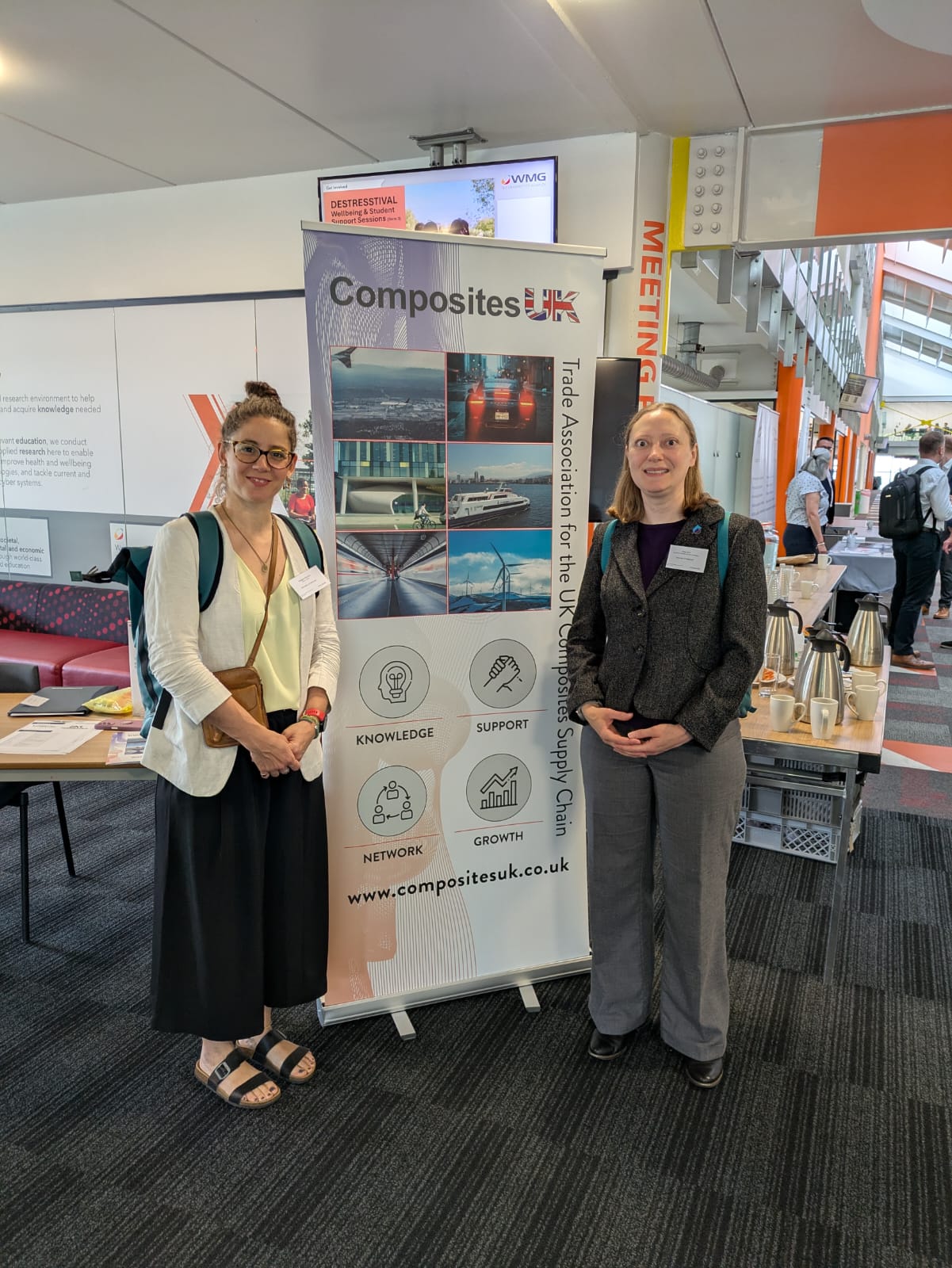
PCAMM attended the Building Resilient National Supply Chains: From Capability to Contract event on Tuesday 30th June at the WGM, University of Warwick, Coventry. An exciting opportunity to hear from experts, leading industries and SMEs about supply chain challenges in the UK and how we can contribute to building a sustainable and resilient future for our industry.
Special thanks to Composites UK for facilitating these insightful and informative discussions.
Events and seminars
We are delighted to invite you to the PCAMM's International Conference Sustainable Materials and Innovations for Circularity (SMIC26), taking place in Portsmouth, UK, from September 10-11, 2026.
Hosted by the University of Portsmouth in the heart of the UK's south coast, a vibrant city that blends culture, history and natural beauty, Portsmouth will provide an excellent destination to combine business, knowledge and leisure!
SMIC26 is organised by PCAMM and the collaboration of the School of Electrical and Mechnical Engineering at University of Portsmouth, offering an opportunity for discussing advanced research, innovation and strengthen collaborations between academia and industry.
World-leading researchers, scientists, scholars and industry experts will come together to share their passion and advances in sustainable materials, circularity and advanced structures. The conference will be held in the state-of-the-art facilities at University of Portsmouth, all located in the heart of the city and within walking distance from hotels, restaurants, attractions and the beatutiful seafront in Southsea, Portsmouth.
Register here!
We look forward to welcoming you to SCIM26 and provide an unforgettable experience in Portsmouth!
Sincerely,
Professor Hom Dhakal
Conference Chair
Director of PCAMM
PCAMM will attend the 29th International Conference on Composite Structures (ICCS29) on the 22-26 June 2026, in Cagliari, Italy. PCAMM will present 4 research oral presentations and 1 keynote talk.
PCAMM will attend the 22nd European Conference on Composite Materials (ECCM22) from 21-25 June 2026 in Oslo, Norway. PCAMM will present 2 research oral presentations and 2 posters.
About us
From Hom Dhakal, Director of the Centre
Thank you for your interest in the ongoing work of the Portsmouth Centre for Advanced Materials and Manufacturing (PCAMM). We're a multidisciplinary centre where a consortium of academics, researchers and industrialists work together to create new optimised future materials for used in many sectors, including aerospace, automotive, energy, construction, packaging and electrical electronic applications.
Billions of barrels of oil. Commuters in smog masks. Heavy metals leaching into the soil. It’s all too easy to picture these things when we think about what transport does to the environment for example. To protect the planet, we must find ways of making materials and processes more sustainable.
PCAMM focuses on applied research into various areas (such as tension, compression, bending, impact, torsion, buckling, fatigue, fracture, thermal, vibration damping, among others) of materials and components aiming at commercialising research and innovation results. With 77% of our research rated world-leading or internationally excellent for impact, our research will directly impact our courses from undergraduate, Masters and PhDs.
